
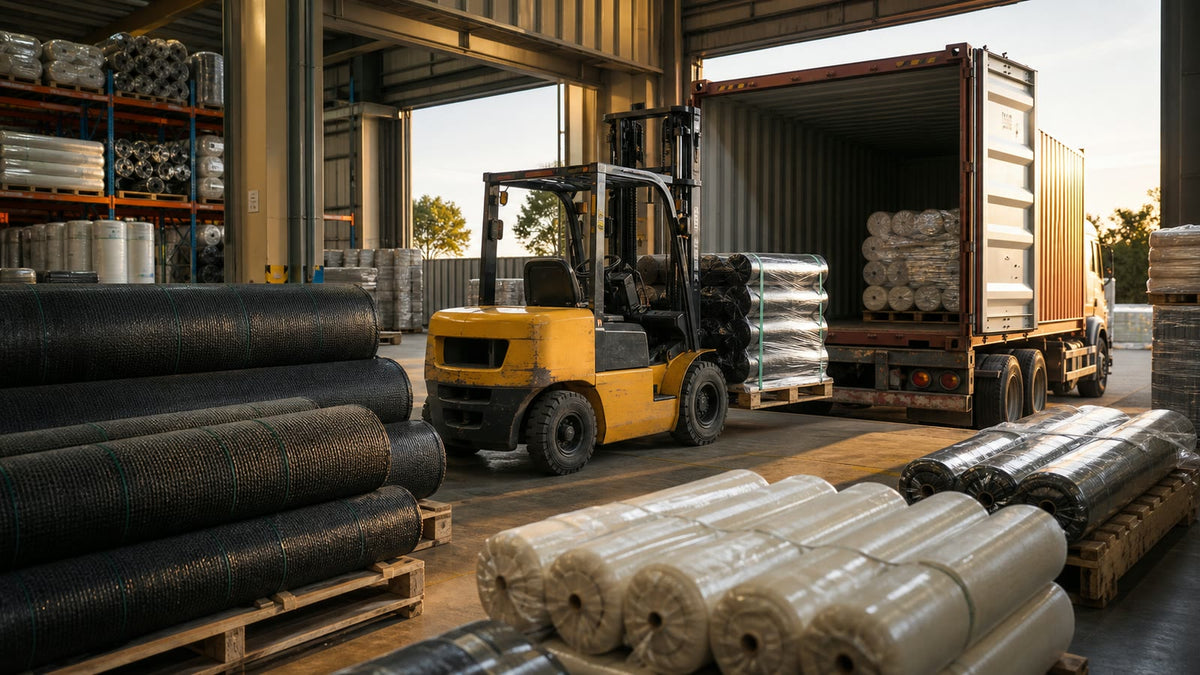
Wholesale agricultural-cover orders work best when the specification is complete before price and freight are compared. FARM GUARD uses a quotation process for commercial quantities, mixed products, custom dimensions, private labels and project delivery.
When to use Wholesale Enquiry
Use the wholesale route for 10 or more rolls, mixed SKUs, repeat distributor supply, OEM packaging, custom construction or delivery to an Australian farm, warehouse or port. Standard listed variants are also supplied only after written quotation and specification confirmation.
Custom-production reference quantities commonly begin around 1,000 m² per specification, but the final factory MOQ depends on material, construction, dimensions, colour and packing. A reference is not an automatic acceptance of an order.
Step 1: identify the product and application
- Product code or material category
- Crop, nursery, greenhouse, orchard, landscape or screening application
- Required colour, GSM, shade percentage or film thickness
- Width, roll length and quantity per specification
- Any required edge finishing, eyelets, guide lines or cores
If the category is not final, start with the crop-protection material selection guide.
Step 2: request sample review correctly
State whether you need a small material swatch, a colour reference or a production-size sample. Sample availability, dimensions, charge and freight are confirmed case by case. A sample should be tied to a written specification; it does not replace approval of the commercial production details.
Do not assume every sample is free or that a sample represents every future batch. For critical performance, agree on the acceptance method, test data or retained reference before production.
Step 3: define labels and packaging
- Private-label artwork and approved brand name
- Roll labels, inserts, barcodes and shipping marks
- Individual wrap, outer bag, carton or pallet preference
- Maximum roll diameter or weight for warehouse handling
- Language and destination-market information
Packaging affects packed volume, freight and handling. Final artwork and markings should be approved before the production schedule is confirmed.
Step 4: provide the delivery basis
Include the Australian postcode, full warehouse or farm location, or preferred commercial port. State whether the site has unloading restrictions. Large rolls can be affected by carrier length limits and cubic volume, so freight cannot be calculated from product weight alone.
Store checkout freight is an estimate for eligible standard orders. Wholesale and project shipments are quoted using the packing plan and destination.
Step 5: confirm lead time rather than assuming it
Lead time depends on material availability, colour, production quantity, custom finishing, artwork approval, testing, packing and the shipping method. FARM GUARD does not use one universal lead-time promise for every product. The quotation or proforma invoice should state the estimated production schedule for the approved specification.
Documents to check before payment
- Product specification and tolerances
- Quantity and unit of sale
- Price, currency and Incoterm
- Sample or pre-production approval status
- Packing and shipping marks
- Estimated production and dispatch schedule
- Freight basis, destination and payment terms
Start the enquiry
Use the Wholesale Enquiry form for a written quotation, review How to Order and Australia Shipping, or browse Farm Protection Products to identify standard reference SKUs.


