
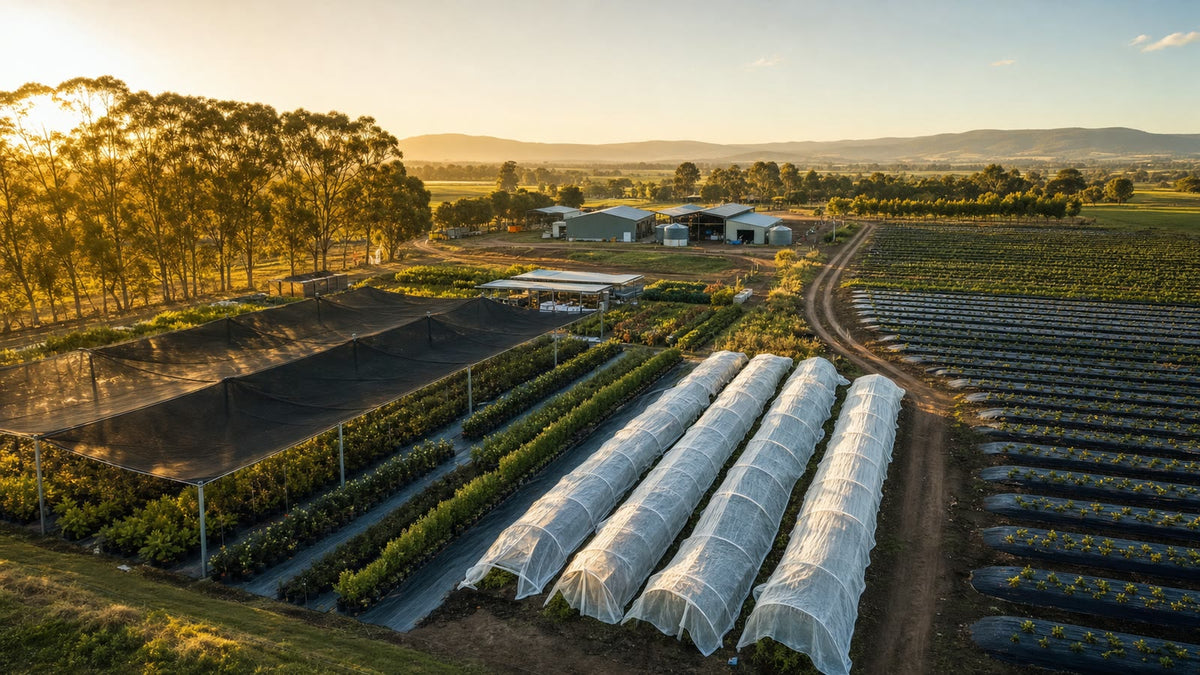
Orchards, nurseries and greenhouses rarely have a single protection problem. A buyer may need to manage solar exposure above the crop, weeds or traffic at ground level, seasonal frost risk and moisture conditions around planting beds. Each material has a different role, so a useful specification begins with the application zone.
Application matrix
| Material | Main application question | FARM GUARD standard range |
|---|---|---|
| Knitted shade net | How much nominal shade and screening is required above or beside the production area? | 50%, 70% and 90% classes |
| Woven ground cover | Does the project need a permeable weed barrier for rows, floors or landscape areas? | 100 GSM and 130 GSM |
| Frost cloth | Is a lightweight seasonal cover required for a monitored cold-weather response? | 30 GSM White and Green |
| PE mulch film | Does a prepared bed need black film integrated with planting and irrigation? | 10, 14 and 15 micron |
Orchards
Woven ground cover can be specified for managed tree rows where weed suppression and a clean working surface are priorities. Mulch film is a different, non-permeable category used over prepared beds in selected crop systems. Neither should be presented as a substitute for complete soil, irrigation and erosion management.
For seasonal cold risk, a lightweight frost cloth may be considered around young or sensitive plants, but frost strategy also depends on site, cold-air drainage, soil heat and monitoring.
Nurseries
Nurseries commonly compare shade net above benches with woven ground cover below. The overhead material is selected for nominal shade, colour, GSM, span and fastening. The floor material is selected for GSM, permeability, roll layout, drainage and traffic.
Compare agricultural shade nets and compare woven ground covers.
Greenhouses and protected cropping
NSW material describes protected cropping broadly as horticultural production under forms of protection such as shade cloth, greenhouses and glasshouses. A shade-net addition should therefore be reviewed with the structure, ventilation and irrigation system rather than selected in isolation.
A woven floor cover can help create a managed surface, but water movement and drainage still need to be checked. Agriculture Victoria notes that irrigation management should meet crop needs while avoiding problems such as runoff and waterlogging; the local design remains the buyer's responsibility.
Specification questions for combined projects
- Which material sits above, beside or below the crop?
- What are the dimensions and support spacings?
- Which standard GSM, shade percentage, colour or thickness is closest?
- What wind, traffic, drainage and maintenance conditions apply?
- Are custom widths, labels, packaging or consolidated freight required?
- Which performance claims need testing or agronomic confirmation?
Buy standard rolls or request a project quotation
View all Farm Protection Products. For mixed materials, commercial quantities and custom specifications, submit one coordinated Wholesale Enquiry.
For detailed selection steps, read the shade cloth percentage guide and the 100 GSM vs 130 GSM comparison.


